Quick answer
Baby hairs are the fine, short hairs along your hairline. A thinning hairline is often caused by tight plaits, ponytails and hijab styles that pull on the edges, as well as heat, pregnancy, genetics or low iron and vitamin D. Wear loose styles and change them often, use soft ties and under scarves, massage the hairline with a few drops of oil for two minutes 2 to 3 times a week, and be patient for three to six months. See a dermatologist for bald patches, pain or scarring.
Look closely at your hairline in the mirror. Do you see short, soft, wispy hairs along your forehead and temples that never seem to grow long? Those are baby hairs. For some people they are a sign of healthy new growth; for others, a hairline that is getting thinner or moving back is a real worry, especially after years of tight plaits, buns and hijab pins, after pregnancy, or for men noticing their temples receding.
This guide explains what baby hairs are, why the hairline thins, the everyday habits common in Pakistan that damage the edges, and a gentle routine to care for your hairline and support baby hairs so the front of your hair looks fuller. It also explains when a thinning hairline is something to see a doctor about.
What are baby hairs?
Baby hairs are the fine, short, soft hairs that grow along the edge of your hairline: at the forehead, the temples and around the ears and nape. They are usually thinner and lighter than the rest of your hair, and they often stay short because they have a shorter growth cycle.
Everyone has some baby hairs. They can be:
- Naturally short hairs that are simply part of your hairline.
- New growth, for example after postpartum shedding, when lots of short hairs appear at the front a few months after a baby is born.
- Broken hairs, snapped off by tight hairstyles, rough towelling or heat, which look similar but have blunt ends.
Fine baby hairs are not a problem by themselves. They become a concern when the hairline is visibly thinner than before, the scalp shows through at the temples, or the edges are clearly moving back.
A quick way to tell new growth from breakage: look at the tips of the short hairs. New baby hairs have soft, tapered, pointed tips. Broken hairs have blunt or split ends, often all at a similar length where the same band or pin rubs every day. If most of your short hairs look broken, the fix is mainly gentler styling and handling.
Why the hairline gets thinner
Tight hairstyles (traction)
This is one of the most common and most preventable reasons in Pakistan. Tight ponytails, buns, choti (plaits), hair pulled back hard under a hijab, heavy hair extensions, and the same tight style every day put constant pulling on the delicate hairs at the front and sides. Over months and years, this can damage the roots so the hairline thins. Doctors call this traction alopecia. Caught early, it often improves once the pulling stops. If it goes on for years, the damage can become permanent.
Hijab and dupatta habits
Wearing a hijab does not cause hair loss by itself. The problem is how it is worn: hair pulled tightly back underneath, a tight under cap (bonnet) worn all day, pins pressing on the same spot, or covering damp hair for hours. Friction from rough fabrics at the hairline also breaks fine hairs.
After pregnancy
Many women notice heavy shedding two to four months after giving birth, often most visible at the temples and hairline. This is a normal hormonal shed. A few months later, lots of short baby hairs usually appear as hair grows back. Read our guide to hair fall after pregnancy.
Genetic thinning
In men, a receding hairline at the temples (the “M” shape) and thinning at the crown is usually male pattern hair loss, which runs in families. Women can also have genetic thinning, usually as a widening parting rather than a receding front. See our guide to hair fall in men.
Heat, chemicals and rough handling
Straighteners, curling irons and blow dryers used close to the forehead, rebonding and keratin treatments, strong hair dyes, and rubbing the hairline hard with a towel all weaken the fine hairs at the edges, so they break.
Health and nutrition
Low iron, low vitamin D, thyroid problems, crash diets, a recent illness with fever, and stress can all cause hair to shed, including at the front. These are common in Pakistan and easy to test for.
A gentle routine to care for your hairline
Hairline care is mostly about two things: stop the damage, and look after the scalp so the hair you have can grow healthily. Here is a routine you can follow every week.
- Loosen your hairstyles. Wear soft, low, loose buns, plaits and ponytails. If a style gives you a headache or you see small bumps at the hairline, it is too tight.
- Change your style often so the pull is not always on the same spot.
- Use soft ties. Fabric scrunchies or spiral ties instead of thin elastic bands with metal joins.
- Oil and massage the hairline 2 to 3 times a week. Put a few drops of oil on your fingertips and massage the hairline and temples in small circles for one to two minutes, as part of your full scalp massage.
- Be gentle when washing and drying. Do not scrub the forehead edge with nails. Pat the hairline dry with a soft cotton towel.
- Keep heat away from the edges. Use a lower heat setting, and keep tools a few centimetres from the hairline.
- Comb gently. Use a soft brush or a fine, smooth comb for the edges, not a hard plastic comb pulled back with force.
The two minute hairline massage
Warm a few drops of oil between your fingertips. Starting at the centre of your forehead, make small, slow circles along the hairline towards each temple, then down in front of the ears. Use light pressure, never nails. Two minutes, two to three times a week, is enough.
Hairline tips for hijab and dupatta wearers
- Never pull your hair tightly back under the hijab. A loose, low bun at the nape puts less strain on the front.
- Choose a soft cotton, bamboo or silk under scarf instead of a tight polyester bonnet.
- Move pins to different spots and do not press them into the same place every day.
- Make sure your hair and scalp are fully dry before covering them.
- At home, take the hijab off and let your hair loose to rest the hairline.
- Wash your under scarves regularly; sweat and oil build up in them.
Which oils help the hairline?
No oil will create new hair follicles where they have been permanently damaged. But a nourishing oil and a regular massage keep the scalp in good condition, soften fine hairs so they break less, and make the edges look healthier and fuller. Oils traditionally used at the hairline include:
- Castor oil: thick and coating, popular for edges and brows. Use a tiny amount, mixed with a lighter oil. See our castor oil guide.
- Rosemary essential oil, always diluted in a carrier oil, never neat. See our rosemary oil guide.
- Coconut, almond, sesame and olive oil as gentle carriers.
- Herbal blends with amla, bhringraj and hibiscus, used in desi hair care for generations.
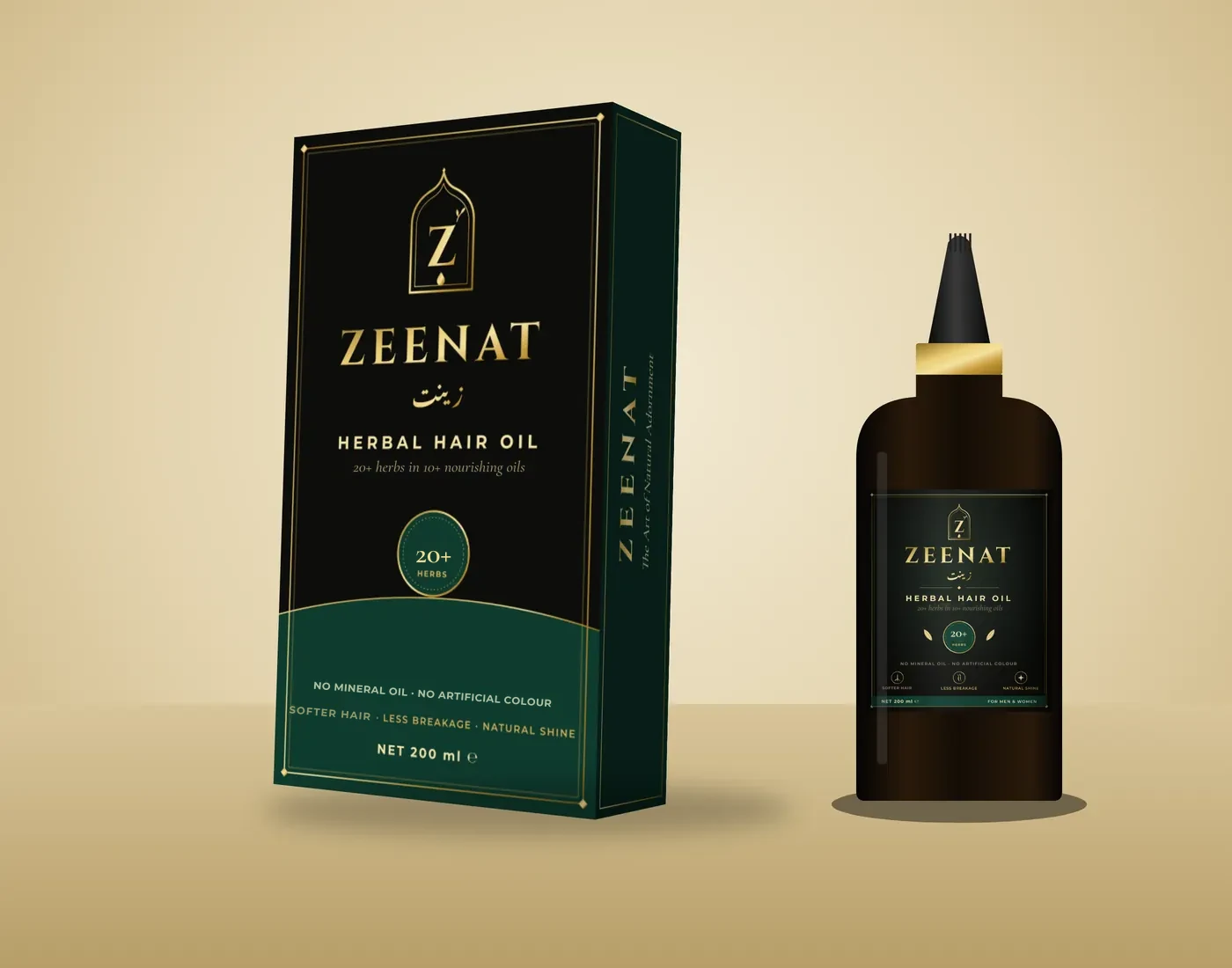
Zeenat Herbal Hair Oil blends castor, coconut, almond, sesame, olive, jojoba and kalonji oils with rosemary and lavender essential oils and 20+ herbs. It nourishes the scalp and the hair roots, and with regular use, 2 to 3 times a week, it helps support fine baby hairs along the hairline and thicker-looking hair. Results vary from person to person, and it is a cosmetic hair oil, not a medicine.
How to style baby hairs
Some people love their baby hairs; others want to smooth them down. If you want them to sit neatly:
- Rub a single drop of oil or a little aloe vera gel between your fingers and smooth the baby hairs in the direction they grow.
- Use a soft toothbrush or edge brush to shape them gently.
- Avoid heavy gels with alcohol every day, which dry out and break fine hairs.
- Do not use strong hair spray close to the edges.
For brides and special events, tell your hair stylist to avoid pulling the front too tight and to use fewer pins at the temples. Read our bridal hair care routine for more.
Hairline care for men
Men in Pakistan often notice the hairline first at the temples, in their twenties or thirties. A little rounding of the hairline as boys become men is normal; this is called a mature hairline and is not hair loss. A hairline that keeps moving back, with thinning at the crown, is usually male pattern hair loss, which runs in families.
For men, the same gentle habits help keep the hair you have in good condition: oil and massage the scalp 2 to 3 times a week, avoid heavy gels and wax every day, do not wear tight caps or helmets on damp hair, and eat well. But oils and massage cannot reverse genetic thinning. If your hairline is moving back quickly, see a dermatologist early: there are medical treatments that can slow it down, and they work best when started soon.
Baby hairs after pregnancy
Many new mothers in Pakistan are surprised to see a ring of short, spiky hairs around the face about six months after giving birth. This is good news: it is new hair growing back after the normal postpartum shed. These hairs can stick up and be hard to style for a while. Be gentle with them, avoid tight hairstyles that snap them off, smooth them with a drop of oil, and give them time to grow out. Most women find the hairline looks normal again within a year.
Food for healthy hair growth
Your hair grows from inside. To give new hairs a good start:
- Protein at every meal: daal, chana, eggs, chicken, fish, dahi and milk.
- Iron: red meat, liver, palak, chana, lobia, with a source of vitamin C like lemon or amla to help absorb it.
- Zinc: pumpkin seeds, meat, nuts.
- Vitamin D: some sun on your skin, eggs, fish. Many Pakistanis are low in vitamin D.
- Healthy fats: walnuts (akhrot), almonds, flaxseed.
How long does it take?
Hair grows about one centimetre a month, and baby hairs are slow to become noticeable. Once you stop tight styles and start a gentle routine, give it at least three months, and often six, before judging the change. Take a photo of your hairline in the same light every month so you can compare fairly; looking in the mirror every day makes it hard to see progress.
When to see a doctor
See a dermatologist if you notice:
- Smooth, round bald patches anywhere on the scalp.
- Redness, scaling, pain, bumps with pus, or scarring at the hairline.
- A hairline that is moving back quickly, especially in women.
- Thinning eyebrows along with the hairline.
- Hair fall with tiredness, weight change, irregular periods or other symptoms.
Early treatment matters, especially for traction and some types of scarring hair loss, because the sooner the cause is found, the more hair can be saved.
Mistakes to avoid
- Pulling the hair tighter to hide thin edges. It makes the thinning worse.
- Rubbing or scratching the hairline hard when washing.
- Using raw onion, garlic or chilli on the hairline; they can burn the skin.
- Applying undiluted essential oils, which can irritate the skin.
- Wearing the same tight style every day for school, work or the gym.
- Giving up after two weeks. Hair needs months.
Peshani ke chhote, naram baal baby hairs kehlate hain; tight choti, pony aur hijab ke neeche khinche hue baal inhein kamzor kar dete hain.
Baal dheele bandhein, style badalte rahein, aur hafte mein 2 se 3 baar ungliyon ke poron se 2 minute hairline par tel ki halki malish karein.
Gol ganje dhabbe, dard, surkhi ya tezi se peeche jaati hairline ho to skin doctor ko zaroor dikhayein.
Baby hairs and hairline care in short
- Baby hairs are fine, short hairs at the hairline; some are natural, some are new growth, some are broken.
- Tight hairstyles, hijab habits, heat and rough handling are common, preventable causes of a thinning hairline.
- Wear loose styles, change them often, use soft ties and soft under scarves.
- Massage the hairline with a few drops of oil for two minutes, 2 to 3 times a week.
- Eat enough protein, iron, zinc and vitamin D, and be patient for three to six months.
- See a dermatologist for bald patches, pain, scarring or a quickly receding hairline.
Frequently asked questions
What are baby hairs?
Baby hairs are the fine, short, soft hairs along the edge of your hairline at the forehead, temples and nape. Some are natural, some are new growth (for example after pregnancy), and some are broken hairs.
Why is my hairline getting thinner?
Common reasons include tight hairstyles and hijab styles that pull on the edges, heat styling, postpartum shedding, genetic thinning, and low iron, vitamin D or thyroid problems. A dermatologist can help find the cause.
Can a thin hairline grow back?
If thinning is caused by pulling and is caught early, the hairline often improves once the pulling stops and you follow a gentle routine. Long term damage can be permanent, so early action matters.
Does wearing a hijab cause hair loss?
A hijab itself does not cause hair loss. Pulling hair tightly back underneath, a tight under cap, pins in the same place and covering damp hair can damage the hairline. Wear it loosely over soft fabric and keep hair dry.
Which oil is best for baby hairs and the hairline?
A nourishing blend with oils such as castor, coconut and almond and diluted rosemary oil, massaged gently into the hairline 2 to 3 times a week, keeps the scalp in good condition and supports fine baby hairs. No oil can regrow permanently damaged follicles.
How long does it take for baby hairs to grow?
Hair grows about one centimetre a month, so give a gentle routine at least three to six months. Monthly photos in the same light help you see progress.
This article is general hair care information, not medical advice. For heavy, sudden or patchy hair loss, or a painful scalp, please see a dermatologist. Zeenat Herbal Hair Oil is a cosmetic product; results vary from person to person.
Keep reading
- How Long Should You Leave Oil in Your Hair?
- Hard Water and Hair Fall: How to Protect Your Hair at Home
- Dry, Frizzy Hair: How to Get Soft, Smooth Hair at Home
- Bridal Hair Care in Pakistan: A 3 Month Plan Before the Wedding
- Mehndi for Hair: The Complete Guide to Henna at Home
- Amla for Hair: How to Use Amla Oil, Powder and Masks at Home
- Kalonji Oil for Hair: Benefits, Uses and Home Recipes
- Castor Oil for Hair: How to Use Arandi Ka Tel the Right Way
- Summer Hair Care in Pakistan: Beat the Heat, Sweat and Frizz
- How to Get Long, Thick-Looking Hair Naturally: An Honest Desi Guide
- Hair Fall in Men: An Honest Guide to Keeping Your Hair
- Hair Fall After Delivery: A Calm Guide for New Mothers
- Looking for a Rivaaj Mahal Hair Oil Alternative? How to Choose a Genuine Desi Herbal Oil
- Rosemary Oil for Hair: What It Really Does and How to Use It Safely
- Dandruff Treatment at Home: Does Hair Oil Help or Make It Worse?
- Winter Hair Care in Pakistan: Keep Your Hair Soft All Season
- Hair Fall Treatment at Home: A Complete Guide for Pakistan
- How to Oil Your Hair the Right Way
- Best herbal hair oil in Pakistan: how to choose
- Current hair oil offers
- Zeenat Herbal Hair Oil