Quick answer
Rosemary oil is a traditional herb with limited but promising evidence: one small 2015 study found rosemary oil and 2% minoxidil gave a similar increase in hair count after six months in people with pattern hair loss. Never apply rosemary essential oil neat: mix 2 to 3 drops into a tablespoon of carrier oil, patch test, massage into the scalp 2 to 3 times a week, and give it at least 3 months. A ready herbal blend that already contains rosemary is the simplest option.
Rosemary oil is everywhere right now. TikTok and Instagram are full of videos of people spraying rosemary water on their roots, and in Pakistan you can find “rosemary hair oil” from almost every brand, from big names to small home sellers. Many people now search for a rosemary version of the desi oils they already know.
But what does rosemary actually do for hair? Is it better than a traditional herbal oil with amla and bhringraj? Can you put rosemary essential oil straight on your scalp? And is the famous “rosemary vs minoxidil” study as strong as the videos make it sound? This guide answers all of that in plain language, with a safe way to use rosemary at home and an honest look at where it fits in a Pakistani hair care routine.
What rosemary oil is (and what it is not)
Rosemary is a fragrant herb from the Mediterranean, used in cooking and in traditional remedies for centuries. When people say “rosemary oil” they may mean three quite different things, and the difference matters:
- Rosemary essential oil: a very concentrated oil, distilled from the leaves, sold in tiny 10 ml or 30 ml dropper bottles. It is strong and must always be diluted before it touches your skin.
- Rosemary infused oil: rosemary leaves soaked in a carrier oil (like olive or coconut oil). Much milder, and ready to use.
- Rosemary hair oil blends: a ready-made hair oil where rosemary is one ingredient among several oils and herbs. Most “rosemary hair oils” sold in Pakistan are this type.
Rosemary is not a magic hair growth serum, and no rosemary product can promise to regrow hair on bald patches. It is a traditional herb with some interesting early research, which is exactly how it should be treated.
What the research says, honestly
Most of the hype comes from one study published in 2015 in the journal SKINmed. Researchers took about 100 people with androgenetic alopecia (common pattern hair loss) and gave half of them rosemary oil and half of them minoxidil 2%, a medicine for hair loss. After six months, both groups had a similar increase in hair count, and the rosemary group reported less scalp itching.
That sounds impressive, so here is the fine print:
- It was a small study, about 50 people in each group, and it has not been repeated on a large scale.
- It used a low strength of minoxidil (2%), and there was no group that received nothing, so we cannot say how much was the oil and how much was time, massage or chance.
- Nothing changed in the first three months. Any effect took six months of daily use to show.
- It studied pattern hair loss, not hair fall from stress, poor diet, dandruff or breakage.
Some lab and animal studies also suggest rosemary may support circulation in the scalp. So the fair summary is: rosemary is a promising traditional ingredient with limited evidence. It is reasonable to include it in your routine, but not reasonable to expect miracles from it, or to stop a treatment your doctor has given you.
The massage matters too
Many of the benefits people notice from any hair oil come from the routine itself: a regular 5 minute scalp massage, less breakage because the hair is softer, and more attention to the scalp. Whatever oil you use, do not skip the massage.
How to use rosemary oil safely
The number one mistake is putting rosemary essential oil straight onto the scalp. Pure essential oils can irritate and even burn the skin. Always dilute.
Method 1: Add essential oil to a carrier oil
- Take 1 tablespoon of a carrier oil (coconut, almond, olive, sesame or your usual hair oil).
- Add 2 to 3 drops of rosemary essential oil. Not more.
- Patch test behind the ear for 24 hours.
- Part your hair and apply to the scalp with your fingertips.
- Massage for about 5 minutes, leave on for 1 to 2 hours or overnight, then wash with a mild shampoo.
- Repeat 2 to 3 times a week.
Method 2: Rosemary water (rosemary pani)
- Boil 2 cups of water with 2 to 3 tablespoons of dried rosemary (or a handful of fresh sprigs).
- Simmer for 10 to 15 minutes, then cover and let it cool completely.
- Strain into a clean spray bottle.
- Spray on the scalp after washing, or on dry roots, and massage in. No need to rinse.
- Keep it in the fridge and make a fresh batch every 5 to 7 days. If it smells sour or looks cloudy, throw it away.
Rosemary water is light and suits people with an oily scalp who do not like heavy oiling. In a dry Pakistani winter, oil is usually more comfortable.
Method 3: Use a ready blend that already contains rosemary
If measuring drops is not your thing, a ready-made herbal oil with rosemary already blended in is the easiest option. You get rosemary together with traditional desi herbs and several base oils in one bottle, and the amount of essential oil is already controlled.
Pure rosemary oil vs a herbal blend
Both have a place. Here is how they compare for everyday use in Pakistan:
| Rosemary essential oil | Herbal blend with rosemary | |
|---|---|---|
| Ready to use? | No, must be diluted | Yes |
| Moisture for dry hair | None on its own | Yes, from the base oils |
| Traditional herbs | Only rosemary | Rosemary plus amla, bhringraj, shikakai and others |
| Risk of irritation | Higher if not diluted well | Lower, already diluted |
| Good for winter | Needs a carrier oil | Yes, if the blend stays liquid in the cold |
| Best for | People who like to mix their own | People who want one simple bottle |
Rosemary in Zeenat Herbal Hair Oil
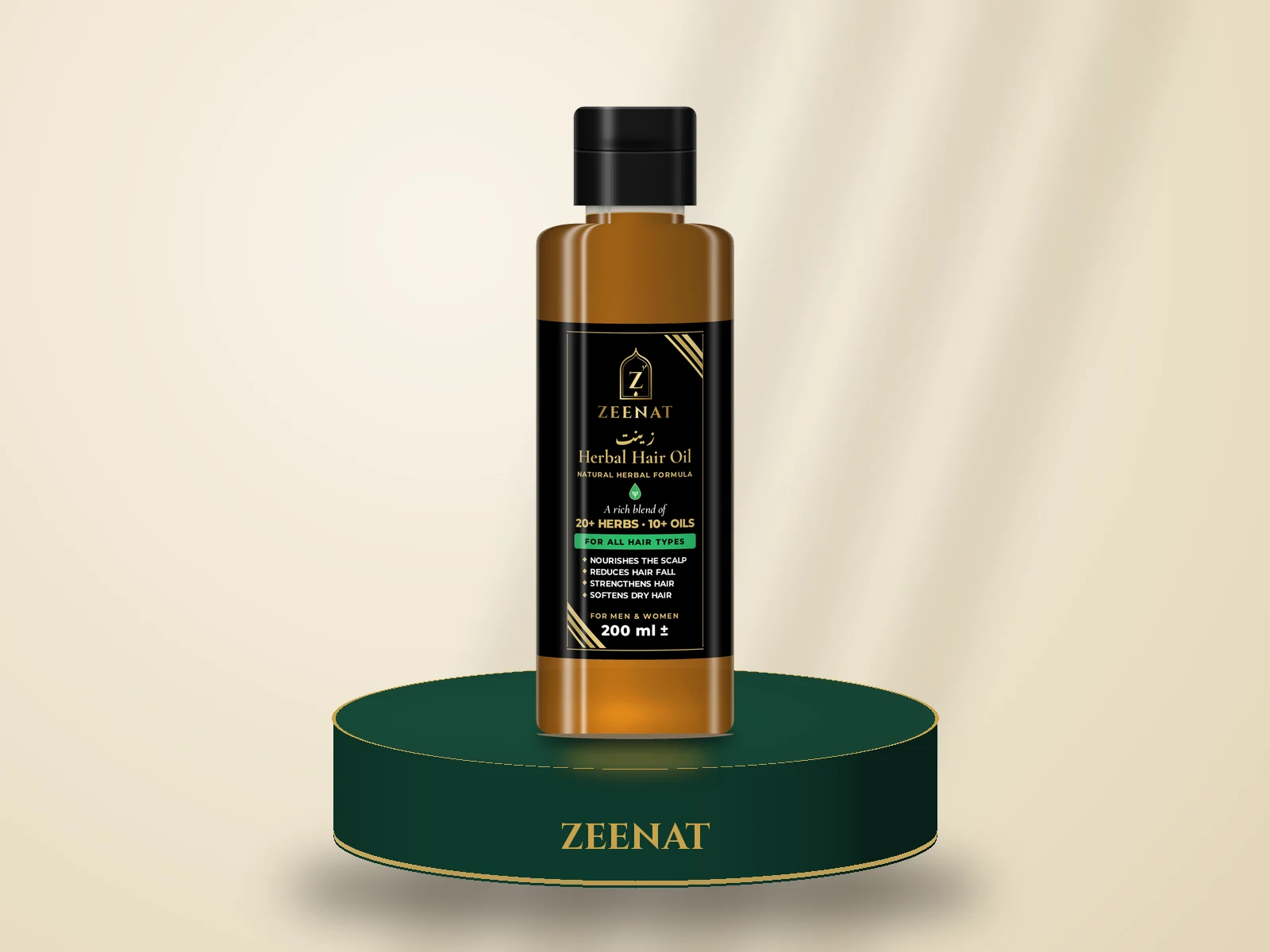
Zeenat Herbal Hair Oil contains rosemary twice: as a herb in the blend and as rosemary essential oil, together with lavender. It sits alongside 20+ traditional herbs (amla, bhringraj, shikakai, brahmi, hibiscus, moringa, mehndi, reetha, curry leaves and more) in 10+ oils including sesame, coconut, almond, olive, castor, jojoba and kalonji oil. The full list is printed on the label and on our product page.
We describe what the oil does as a whole: it nourishes the scalp, softens dry hair, adds shine and helps reduce hair fall and breakage with regular use. We do not claim that any single herb, rosemary included, regrows hair.
Rosemary with desi herbs: a good partnership
Rosemary is new to many Pakistani homes, but it fits naturally next to the herbs our families have always used. Each brings something different to a routine, and together they make a more complete oil than any single herb:
- Amla is the classic South Asian hair herb, used for generations in oils and hair masks.
- Bhringraj, called the “king of hair” in traditional care, is a staple of desi hair oils.
- Shikakai and reetha are the traditional hair cleansers, used before shampoo existed.
- Kalonji (black seed) oil is a household name in Pakistan for scalp care.
- Castor oil is thick and coating, often used on the roots and dry ends.
- Rosemary and lavender add a fresh, herbal scent and are popular for scalp massage.
If you already have a desi herbal oil you like, you do not need to throw it away to try rosemary. You can add 2 drops of rosemary essential oil to one tablespoon of your usual oil just before applying, or simply choose a blend that already has rosemary in it.
Rosemary for men and for women
Men are often drawn to rosemary because of the study on pattern hair loss, which mostly affects men. If you are noticing a receding hairline or thinning on the crown, rosemary oil with a regular massage is a reasonable thing to add, but speak to a dermatologist early, because proven medical treatments work best when started early. Short hair needs very little oil: about one teaspoon, focused on the scalp.
Women more often deal with hair fall from stress, iron deficiency, thyroid problems or after pregnancy, as well as breakage from heat styling and tight hairstyles. Rosemary can be part of a gentle routine, together with a nourishing oil for the lengths, a good diet and less heat. If your hair is thinning across the whole scalp, a simple blood test for iron, vitamin D and thyroid is often a better first step than any oil.
Who should be careful with rosemary
- Sensitive skin or eczema: always patch test, and use a lower dilution (1 drop per tablespoon) or a ready blend.
- Pregnancy and breastfeeding: concentrated essential oils are best used only with your doctor’s approval. Ask before starting.
- Epilepsy or seizures: concentrated rosemary essential oil is usually advised against. Speak to your doctor.
- Children: do not use undiluted essential oils on children’s scalps. A plain mild oil is enough for kids.
- On a hair loss medicine: do not swap a doctor’s treatment for rosemary without asking your doctor.
How long before you see results?
Hair grows slowly, about 1 cm a month. Softness and shine from oiling show within a few washes. Less breakage, fewer hairs in the comb and a calmer scalp take 6 to 12 weeks of regular use. Any change in thickness, if it comes, takes several months, which is why the 2015 study ran for six months. Take a photo of your parting in good light on day one, then compare after three months instead of checking the mirror every day.
If you are using oil regularly and still losing a lot of hair, the cause is probably not something an oil can fix: iron or vitamin D deficiency, thyroid problems, stress, crash diets, hormones or hair fall after pregnancy. Our hair fall treatment at home guide explains the common causes and when to see a doctor.
Common rosemary mistakes
- Using it neat. Undiluted essential oil can irritate and burn. Always dilute.
- Using too much. More drops do not mean faster results. 2 to 3 drops per tablespoon is plenty.
- Leaving old rosemary water out. Homemade rosemary water spoils within a week, faster outside the fridge.
- Giving up after two weeks, or expecting it to work like a medicine.
- Buying the cheapest “pure rosemary oil”. Real essential oil is not cheap. Very low prices often mean a diluted or fragrance oil. Buy from a seller you trust.
- Forgetting the basics: a gentle shampoo, conditioner, less heat styling, a good diet and enough sleep matter just as much.
A simple weekly routine with rosemary
- Twice or three times a week: warm a rosemary herbal blend, massage into the scalp for 5 minutes, leave for 1 to 2 hours or overnight, then wash. See how to oil your hair the right way.
- On wash days (optional): spray rosemary water on the scalp after washing if your scalp is oily and you prefer something light.
- Every day: comb gently with a wide tooth comb, avoid tight ponytails, and protect hair from sun and dust.
- In winter: follow our winter hair care tips, as dry air and hot water undo a lot of good oiling.
One 200 ml bottle of Zeenat lasts one person about 5 to 8 weeks at 2 to 3 oilings a week. Because results take a few months, many customers take the 2 Bottle Deal or the 3 Bottle Deal so they do not run out halfway.
Rosemary ka essential oil kabhi seedha sar par na lagayein. 1 bara chamach nariyal, badam ya apne tel mein sirf 2 se 3 qatre milayein.
Rosemary pani: 2 cup pani mein 2 se 3 chamach sookhi rosemary 10 se 15 minute pakayein, thanda karke spray bottle mein fridge mein rakhein.
Nateeje ke liye kam az kam 3 mahine baqaida istemal karein. Rosemary madadgar hai, jadoo nahi.
In short
- Rosemary is a traditional herb with limited but promising research, mainly one small six month study.
- Never use rosemary essential oil neat: 2 to 3 drops per tablespoon of carrier oil, and patch test first.
- Rosemary water is a light option for oily scalps; oil is better for dry hair and winter.
- A herbal blend with rosemary gives you rosemary plus desi herbs and moisturising oils in one bottle.
- Give any routine 3 months, and see a doctor for heavy, sudden or patchy hair loss.
Frequently asked questions
Does rosemary oil really help hair growth?
There is some early evidence. A small 2015 study found rosemary oil and 2% minoxidil gave a similar increase in hair count after six months in people with pattern hair loss, but the study was small and has not been repeated widely. Treat rosemary as a helpful traditional ingredient, not a guaranteed treatment.
Can I apply rosemary essential oil directly on my scalp?
No. Pure essential oil can irritate the skin. Mix 2 to 3 drops into a tablespoon of a carrier oil such as coconut, almond, olive or your usual hair oil, and patch test for 24 hours first.
How do I make rosemary water for hair?
Simmer 2 to 3 tablespoons of dried rosemary in 2 cups of water for 10 to 15 minutes, cool it covered, strain into a spray bottle and keep it in the fridge. Spray on the scalp and massage in. Make a fresh batch every 5 to 7 days.
Is rosemary oil better than a herbal hair oil?
They do different jobs. Rosemary essential oil is a single concentrated herb that must be diluted. A herbal blend gives moisture from several base oils plus herbs like amla, bhringraj and shikakai. Many people use a blend that already contains rosemary, such as Zeenat Herbal Hair Oil.
How long does rosemary oil take to work?
Softness and shine show within a few washes. Less breakage takes 6 to 12 weeks of regular use. In the 2015 study, changes in hair count only appeared after six months.
Who should not use rosemary essential oil?
People with very sensitive skin should patch test and dilute more. Pregnant or breastfeeding women, people with epilepsy and anyone on hair loss medicine should ask their doctor first. Do not use undiluted essential oils on children.
This article is general hair care information, not medical advice. For heavy, sudden or patchy hair loss, or a painful scalp, please see a dermatologist. Zeenat Herbal Hair Oil is a cosmetic product; results vary from person to person.
Keep reading
- How to Get Long, Thick-Looking Hair Naturally: An Honest Desi Guide
- Hair Fall in Men: An Honest Guide to Keeping Your Hair
- Hair Fall After Delivery: A Calm Guide for New Mothers
- Looking for a Rivaaj Mahal Hair Oil Alternative? How to Choose a Genuine Desi Herbal Oil
- Dandruff Treatment at Home: Does Hair Oil Help or Make It Worse?
- Winter Hair Care in Pakistan: Keep Your Hair Soft All Season
- Hair Fall Treatment at Home: A Complete Guide for Pakistan
- How to Oil Your Hair the Right Way
- Best herbal hair oil in Pakistan: how to choose
- Current hair oil offers
- Zeenat Herbal Hair Oil